
The Peculiar Truth about the Dead Pope’s Trial
- Dan Spencer

- Aug 18
- 2 min read
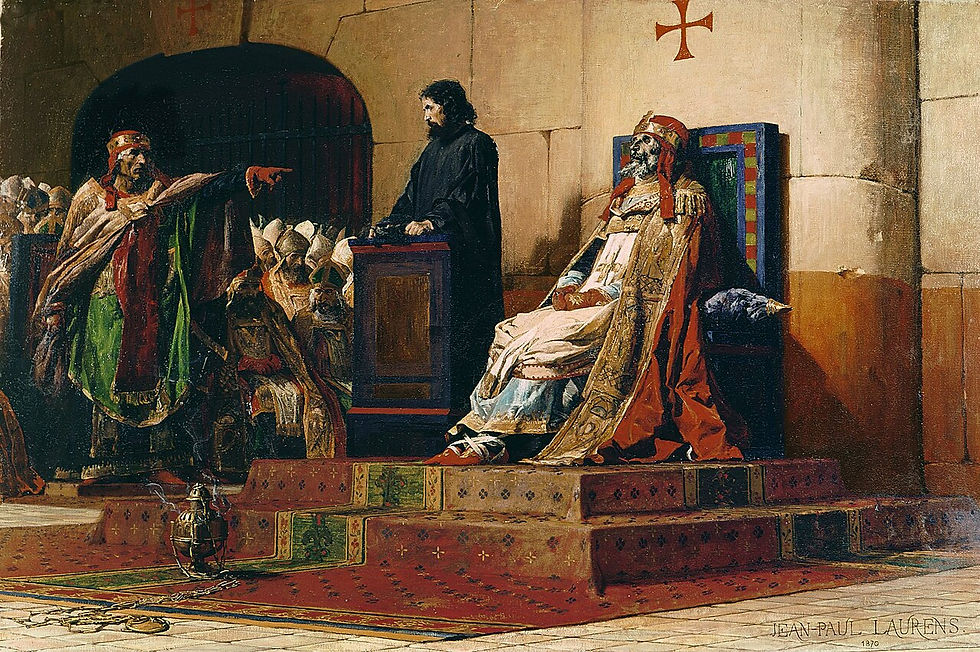
January in the year 897: A cadaver was removed from its crypt. The skeletal remains were adorned with robes and finery and placed on a throne. Then a clergyman was chosen to defend the corpse, and it was put on trial.
The dead defendant was a former Pope. He had died nine months earlier.
The trial became known as the Cadaver Synod.
In the years before the odd litigation, Popes were selected and then subsequently died in rapid succession. Many were murdered.
Pope John VIII was assassinated in December 882. His assailant tried to poison him, grew impatient with the slow-acting poison, and instead cracked his skull until the Pope died.
Pope St. Adrian III was killed in July 885. He was in office barely a full year.
Pope St. Stephen V took over the papacy and lasted for six years, one of the longest reigns of the era.
Pope Formosus was elected in 891 and died from a stroke in April 896. His church leadership was marred by controversy.
His successor, Pope Boniface VI, lasted a little over two weeks. He was either poisoned or had a heart attack.
Next came Pope Stephen VI in the spring of 896. He didn’t last long, either. But during his time in the Vatican he conducted a peculiar legal proceeding.
Stephen VI believed his predecessor, Formosus, held the papacy illegally. So he put him on trial - despite being dead. The Pope ordered that Formosus’ corpse be collected and appear in court.
Formosus was accused of fraud for claiming to be a bishop despite never being ordained as such. His ascension to the papal throne, therefore, was improper.
The accusation posed a problem, however. During his life, Formosus had previously ordained Stephen VI as a bishop. Therefore, if Formosus’ papacy was a fraud, the same was true of Stephen VI. In which case neither of them deserved to be Pope.
The deceased man was found guilty. A death sentence would have been redundant.
Instead, three of his dead fingers were chopped off to undo any blessings he bestowed during his papacy. All ordinations he gave during his reign were declared null and void. All clergy had to be ordained again. Except Stephen VI.
Then the body of Formosus was placed in a potter’s field. Later, it was exhumed and dumped into the Tiber River. When the rotting cadaver washed onto dry land, local residents weren’t happy.
Public opinion turned against Pope Stephen VI. They replaced him with another Pope and threw him in prison. While incarcerated, Stephen VI was strangled to death.
The next pontiff, Pope Theodore II, reversed the Cadaver Synod and reinstated Formosus’ papal status, thereby restoring all of his former blessings.
Theodore II also enacted a church rule that forbid ever again putting a corpse on trial.
Theodore’s reign as Pope lasted less than three weeks. Foul play was suspected in his sudden death, too.
It was a bad time to be a Pope.

Comments